

The Yellow Brick Road
What The Wizard of Oz Teaches Us About Personal Power

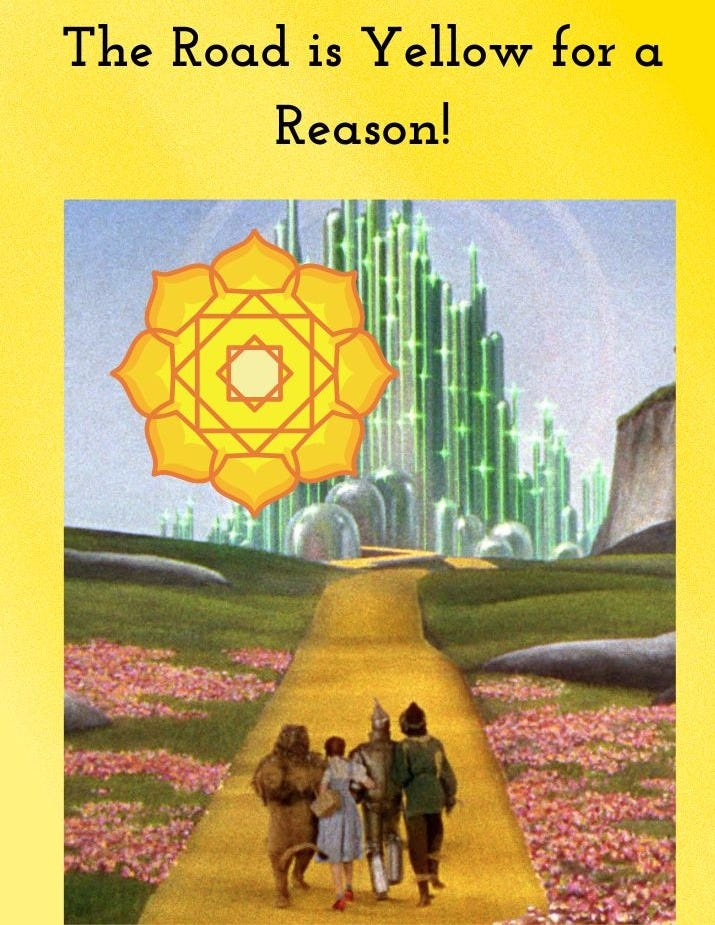
Image created by the author using Canva.
Original imagery from The Wizard of Oz (1939), directed by Victor Fleming, Metro-Goldwyn-Mayer (MGM). Used here for commentary and educational purposes.
The Wizard of Oz is often remembered as a whimsical story about a girl trying to get home, but beneath the music and technicolor spectacle is a far more instructive tale about personal power. At its core, this is a story about confidence, choice, identity, and the belief that I can. And like most lessons involving personal power, the wisdom doesn’t arrive through certainty. It arrives through doubt, misdirection, and the courage to keep walking anyway.
The Yellow Brick Road: A Map to Your Power Center
The yellow brick road is impossible to miss. Bright, bold, unmistakable. Yellow is the color of the solar plexus chakra, the energetic center located just above your navel that governs will, self-esteem, decision-making, and autonomy. It determines how you move through the world once your basic needs are met, how you trust yourself, and how you respond when life asks you to choose without guarantees.
Dorothy doesn’t step onto that road feeling empowered. She steps onto it because she has no other option. And that, too, is a solar plexus truth: confidence is often built after the decision, not before it.
At the beginning of the journey, Dorothy hands her power away almost immediately. She’s told where to go, what to do, and who has the answers. That’s a classic solar plexus imbalance—outsourcing authority, believing someone else knows better, assuming guidance must come from outside rather than within.
She’s not weak. She’s unsure. And uncertainty doesn’t mean we lack power. It means we haven’t learned how to trust it yet.
The Companions: Reflections of Our Own Disconnection
As Dorothy walks the road, she gathers companions who each reflect a different relationship to personal power.
The Scarecrow believes he can’t think for himself. He dismisses his own ideas as worthless, constantly deferring to others even though he’s the one consistently solving problems along the way.
The Tin Man believes he can’t feel or love fully. He’s convinced something essential is missing from him, that he’s fundamentally broken, even as he demonstrates tenderness and care at every turn.
The Lion believes courage is something you’re given, not something you practice. He waits for external validation to prove his bravery rather than recognizing that showing up despite fear is courage.
None of them is actually missing what they think they are. They are simply disconnected from their own agency. Like so many of us, they’ve mistaken external validation for internal truth. They’re waiting for someone else—the Wizard, an authority figure, anyone—to tell them they’re enough.
The Wizard: When Power Becomes Performance
The Wizard himself is perhaps the most revealing lesson of all. He is all spectacle and smoke, inflated authority and booming voice—a perfect image of what happens when power is performative rather than embodied.
He appears larger than life, but behind the curtain is fear, insecurity, and a desperate attempt to maintain control. This is solar plexus imbalance in its shadow form: domination instead of leadership, illusion instead of confidence, control instead of trust.
He’s gripping power so tightly because deep down, he doesn’t believe he has any real authority. So he creates an elaborate performance, hoping no one will notice the ordinary man behind it all.
Sound familiar?
How many of us perform competence while feeling like frauds? How many of us micromanage everything because we’re terrified someone will discover we don’t actually know what we’re doing? How many of us dominate conversations, demand control, or refuse to delegate because loosening our grip feels like losing ourselves entirely?
And yet, the growth doesn’t come from overthrowing the Wizard in anger. It comes from seeing clearly. From recognizing that no one was ever truly powerless. They simply forgot how to claim what was already theirs.
You Already Have What You Need
By the time Dorothy realizes she had the power to go home all along, she is no longer the same person who landed in Oz. The journey didn’t give her power, but it taught her to recognize it.
That distinction matters.
Because when we believe power is something we must receive, we stay dependent. When we understand it’s something we cultivate, we become sovereign.
The yellow brick road isn’t a promise of ease. It’s a commitment to engagement, participation and to staying present with the choices in front of us rather than waiting for certainty to arrive.
And that, perhaps, is the most essential truth: empowerment isn’t about knowing the outcome. It’s about trusting yourself enough to take the next step.
Sometimes the road is clear and sometimes it twists. Sometimes the guidance is questionable, the authority unreliable, and the destination unclear. But each step strengthens the inner muscle of self-trust. And like any muscle, the solar plexus grows not by avoiding effort, but by using it.
The solar plexus chakra doesn’t activate through affirmation alone. It activates through experience of choosing, failing, adjusting, and choosing again. Through walking the road even when the destination feels uncertain. Through discovering that courage isn’t the absence of fear, confidence isn’t loud, and empowerment doesn’t require permission.
In the end, the magic wasn’t in Oz. It was in the willingness to walk, to choose, and to believe, even if it takes many steps along the path to get there, that you already have what you need.
Where Are You on the Yellow Brick Road?
Maybe you see yourself in Dorothy as unsure, looking for external guidance, convinced someone else has the answers you’re missing. Maybe you’re the Scarecrow, dismissing your own intelligence and ideas. Maybe you’re the Tin Man, believing you’re fundamentally broken or missing something essential. Maybe you’re the Lion, waiting for someone to give you permission to be brave. Or maybe you’re the Wizard, performing confidence while terrified someone will see through the curtain.
The solar plexus chakra governs your ability to trust yourself, make decisions from your center, claim your identity beyond your roles, and step into your power without apology or domination. When this energetic center is out of balance, it manifests in specific, recognizable patterns.
You might be experiencing solar plexus imbalance if you:
Constantly second-guess yourself, even in areas where you’re competent
Wait for permission to do things you’re already qualified to do
Micromanage everything because you can’t trust others
Apologize for existing, for taking up space, for having needs
Measure your worth entirely by achievement and accomplishment
Feel like an imposter in your own life
Defer to others even when you know the answer
Need constant external validation to feel capable
Dominate conversations because staying in control feels safer than being vulnerable
Burn yourself out trying to prove you’re enough
These patterns aren’t permanent states. They’re signs that your solar plexus needs attention, that old programming is running the show, that your inner guidance system needs recalibration.
Want to step onto your own yellow brick road?
In a paid section below, I’ll walk you through:
Quick Self-Assessment: 5 signs your solar plexus is spinning too slowly (deficient/sluggish), 5 signs it’s spinning too fast (excessive/controlling), and what balanced power looks like
5 Practical Rebalancing Tools: Simple, actionable practices to reconnect with your inner authority and build genuine confidence
Guided Solar Plexus Meditation: A complete breathwork and mudra practice designed to activate your power center, release self-doubt, and strengthen your inner fire
This isn’t about becoming louder or more aggressive. It’s about reconnecting with the power that’s already yours, learning to trust your inner knowing, and walking your road with clarity and confidence.
For more work on your Solar Plexus and how to determine if yours needs your attention, please upgrade to paid to read on!
Namaste, and thank you for reading!
xo
Lauri
This essay includes interpretive commentary on The Wizard of Oz (1939), directed by Victor Fleming and produced by Metro-Goldwyn-Mayer (MGM). References to characters and story elements are used for cultural, educational, and transformative purposes.
©Lauri Stern - Custom Designed Wellness
Permissions: No part of my publications may be reproduced or distributed in any form or by any means without prior consent from Custom Designed Wellness or Lauri Stern.
You must not:
Publish material from this website without prior written consent.
Sell or rent materials from this website.
Reproduce, duplicate, download, create derivatives, copy, or otherwise exploit material on this website for any purpose.
Redistribute any content from this website, including onto another website.
Requests for permission should be directed to lauri@customdesignedwellness.com
Keep reading with a 7-day free trial
Subscribe to Lauri Stern - Custom Designed Wellness: Insights and Stories to keep reading this post and get 7 days of free access to the full post archives.