

The Search for Home:
What The Cat in the Hat and A Mother for Choco Teach Us About Belonging

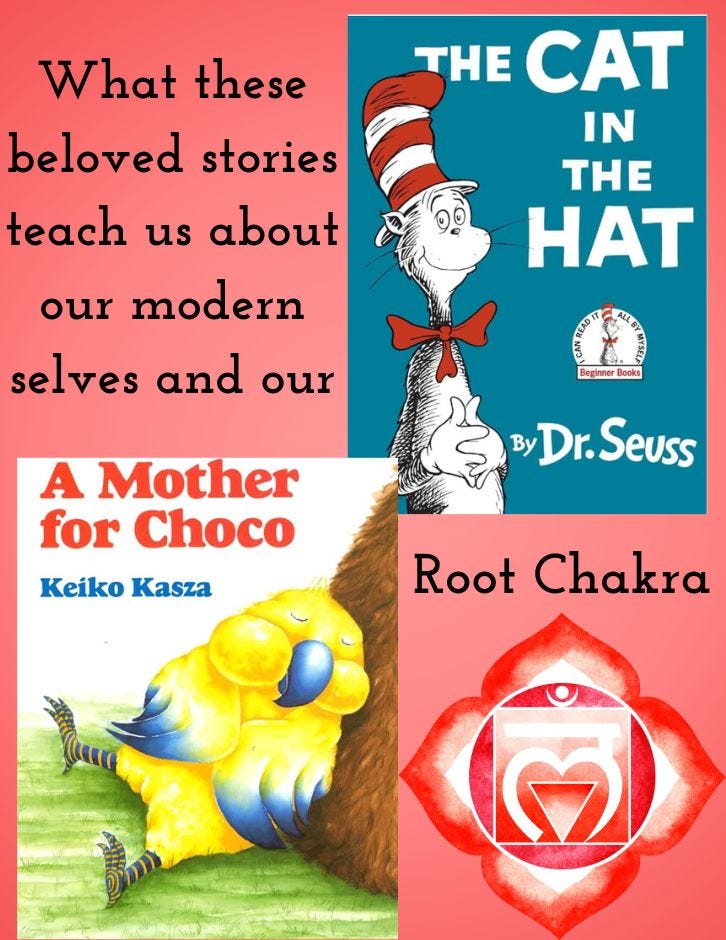
Book cover images used for educational/commentary purposes. The Cat in the Hat by Dr. Seuss (1957) and A Mother for Choco by Keiko Kasza (1992).
Dorothy clicked her heels and said it best: “There’s no place like home.” But what does home actually mean? And more importantly, how do we recognize it when our nervous system has never experienced it as safe?
Home isn’t a building. It isn’t a family structure that looks a certain way. Home is the place where your body can finally exhale. Home is where the ground beneath you feels predictable enough to relax into. Home is where someone shows up, day after day, not because you’ve earned it, but because you belong there.
This is the wisdom of the root chakra, your foundation wheel, the energy center that governs safety, security, belonging, and the fundamental truth that you have a right to exist exactly as you are.
Two children’s stories reveal everything about what happens when that foundation is solid, and what happens when it’s not. One story is chaotic. One is quiet. Both teach us about home. And both are stories we may know, love, remember, and perhaps read to our own children, or any children in our lives.
I spent many evenings with my own kids reading these, replete with voices for each character, and as I do with familiar songs (see my blog posts, soon moving over here!) I enjoy taking familiar content and reframing it through a modern lens to help readers and my clients connect with the information in unexpected ways.
The Cat in the Hat: When Structure Disappears
The story begins with a simple setup: Mother is gone. The children are alone. The rules are suspended. And then the Cat arrives.
What happens next is not misbehavior. It’s dysregulation.
The Cat doesn’t create the instability. He reveals it. The house becomes a container without a lid. Things fly. Boundaries dissolve. The chaos escalates not because the children are bad, but because their nervous systems are asking a question they can’t articulate: Am I still safe?
Anyone who has parented through the last weeks of school, a sudden schedule change, or the arrival of a substitute teacher recognizes this pattern immediately. The behavior isn’t about defiance. It’s about uncertainty. When the structure that held them disappears, when the person who usually shows up doesn’t, the body searches for something that feels solid again. The body searches for anything that feels solid again.
I’ve witnessed this exact dynamic teaching yoga. When I’m there, my regular students arrive on time, settle into their mats, and follow the flow or respectfully deviate as desired, depending on their body’s capabilities and wants that day. But when there’s a substitute? Some misbehave by arriving late when they usually wouldn’t, talking more throughout class, or choosing not to show up at all because they prefer their regular teacher.
To this last one: I’ve been on both sides of this as the sub and the student. I understand the comfort a regular routine provides, yet appreciate the opportunities, wanted or unwanted, to deviate from them. I always learn something new from a sub, whether it’s a song or a cue I’ve never heard, or the ways I see clearly my own impatience and rigidity with experiencing someone new.
Root chakra energy understands something essential. Safety is created through consistency, not control. It’s created when expectations are clear and when someone reliable is holding the edges of the experience. When that holding disappears, the system looks for stimulation, distraction, or disruption as a way to feel something solid again.
Chaos, in this context, is not a failure.
It is communication.
The Mother for Choco: The Quiet Search for Belonging
Choco tells the other side of the same story.
Choco is not disruptive or loud. He is searching. He goes from creature to creature, asking the same question in different forms: Do I belong with you? Are you my family?
He’s rejected again and again, not because he’s unworthy, but because he doesn’t match the expected shape. The giraffe has a long neck. The penguin has flippers. Mrs. Bear doesn’t look like Choco at all. But Mrs. Bear does something none of the others did. She recognizes that family isn’t about matching. It’s about showing up.
She doesn’t require Choco to change. She makes room for him exactly as he is. She holds him, feeds him, plays with him, and tucks him in at night. The structure she provides isn’t rigid. It’s reliable. And within that reliability, Choco’s nervous system finally settles. He stops searching. He’s home.
What finally grounds Choco is not novelty or excitement, but being held within a structure that says, you belong here. Not because you look right or act right, but because you’re here and we choose you.
Safety, in this story, is not sameness.
It is acceptance.
What These Stories Reveal About Your Foundation
The root chakra is not built on ideas of safety. It is built on repetition. On what happens every day. On who shows up, who leaves, and whether the ground beneath us feels predictable enough to relax into.
For children especially, security is not something they think about. It is something their bodies register. When structure holds, behavior settles. When it doesn’t, the nervous system searches for reassurance in ways that often look like chaos.
But this isn’t just true for children. It’s true for all of us.
When your root chakra is unstable, you become the kids in The Cat in the Hat. You’re looking for something, anything, to feel grounded, even if that means creating chaos. Or you become Choco, searching and searching for a place where you finally fit, where someone will choose you without requiring you to change your essential nature first.
The Cat in the Hat reveals deficient root energy gone haywire. When there’s no structure, no predictable presence, the nervous system panics. You might numb out entirely, going through the motions without really being present. Or you might spin into chaos, overworking, over-functioning, creating drama because at least drama feels like something.
Choco reveals what happens when belonging feels conditional. You search for proof that you matter. You try to match the shape others want. You apologize for your differences. You stay small, hoping that if you just behave well enough, someone will finally let you stay.
Together, these stories reveal something essential. Home is not defined by perfection, nor by traditional shapes. Home is the place where the nervous system can settle.
Where expectations are consistent enough to allow play. Where care is not conditional on behavior. Where someone notices when things feel off and responds with steadiness rather than punishment.
Recognizing Your Own Pattern
Maybe you’re the kids when the Cat shows up. You’re seeking stimulation, distraction, or chaos because when your internal structure disappeared through trauma, instability, or neglect, you never learned how to create it for yourself. You might micromanage everything because loosening control feels like the house will literally fall apart. Or you might swing the other way, completely checked out, numb, going through the motions because being present is too painful.
Maybe you’re Choco, still searching for the family that will accept you as you are. You measure your worth by what you give others. You keep mental tallies of who shows up for you versus who doesn’t. You apologize for existing, for having needs, for taking up space. You’re terrified that if you stop being useful, stop matching what others need, you’ll be rejected again.
Or maybe you had a Mrs. Bear in your life, someone who provided the structure, the consistency, the unconditional acceptance that allowed your nervous system to settle. And now you’re trying to become that for yourself, or for others, but you’re not quite sure how because you’re still carrying wounds from all the times before someone finally showed up.
The root chakra does not judge how home is formed. It only asks whether it provides stability, structure, and a sense of being held.
For some, home is a family of origin. For others, it is chosen. For some, it is a routine, a practice, a room that feels like refuge. For others, it is something they had to build themselves after growing up without it.
When the Foundation Cracks
You might be experiencing root chakra imbalance if you:
Feel chronic anxiety about money, housing, or basic security even when you’re objectively stable
Stay in situations that no longer serve you because leaving feels too risky, because better the devil you know
Go through the motions of your life but feel numb and disconnected, like you’re watching from outside yourself
Need to control every detail because loosening your grip feels like everything will fall apart
Test boundaries constantly or struggle when routines change, even small ones
Feel like you don’t belong anywhere, even in rooms full of people who love you
Measure your worth by what you give to others or keep mental tallies of who shows up versus who doesn’t
Apologize for existing, for having needs, for taking up space
Define yourself entirely through your roles and can’t remember who you are underneath
Create chaos or seek stimulation when things feel too calm because calm doesn’t feel safe
Withdraw completely when structure disappears instead of asking for help rebuilding it
These patterns aren’t character flaws. They’re signals that your foundation needs attention. That your nervous system learned early on that ground could shift without warning, that people who said they’d stay might leave, that home wasn’t a place you could count on.
When those needs are met, when structure is consistent, when someone shows up reliably, when acceptance isn’t conditional, creativity softens. Emotions regulate. Curiosity becomes safe.
When they are not, the system looks for grounding in whatever ways it can find. Sometimes that looks like acting out, like the Cat in the Hat chaos. Sometimes it looks like withdrawal, like Choco searching and searching but never settling.
Both are signals, not flaws.
Ready to find your Mrs. Bear?
If you prefer audio, you can listen to the full episode where I walk through these practices and guide you through the meditation. [Embed podcast episode here]
In the paid section below, I’ll share the written versions of everything so you have a reference guide you can return to, print, or save:
The Cat or Choco Assessment: Identify your pattern and what your nervous system actually needs
The Three Daily Practices: Written guides for the Morning Anchor, Feet-on-Floor Reset, and Evening Tally so you can reference them anytime
The “You Belong Here” Meditation: Full script you can save, print, or follow at your own pace
Root Chakra Integration Guide: How to build these practices into your life and track your progress
The work of the root chakra is simple and profound. To create conditions where you feel safe enough to be yourself. To recognize when chaos is a request for structure. And to remember that home is not a place you earn by behaving well. It is the foundation from which you learn how to live.
May you feel at home within yourself and wherever you go!
And if you’d like to listen or view the podcast I published that connects with all of this, head to anywhere you listen to podcasts as well as my YouTube channel.
In light,
Lauri
Books mentioned:
The Cat in the Hat by Dr. Seuss (1957) and A Mother for Choco by Keiko Kasza (1992)
©Lauri Stern - Custom Designed Wellness
Permissions: No part of my publications may be reproduced or distributed in any form or by any means without prior consent from Custom Designed Wellness or Lauri Stern.
You must not:
Publish material from this website without prior written consent.
Sell or rent materials from this website.
Reproduce, duplicate, download, create derivatives, copy, or otherwise exploit material on this website for any purpose.
Redistribute any content from this website, including onto another website.
Requests for permission should be directed to lauri@customdesignedwellness.com
